



Forests get a lot of attention within the voluntary carbon market for their potential to capture and store carbon, but this is only one mechanism by which forests impact our climate. Forests also play an important role in energy and water dynamics on the Earth's surface. Decades of scientific research have advanced our understanding of these feedback loops between forests and the climate, yet these processes are overlooked within the voluntary carbon market.
One feedback mechanism that has started to gain more attention is albedo change. Albedo describes how much incoming solar energy the Earth's surface reflects back into space. Generally, lighter colored surfaces have a higher albedo and reflect more solar energy than darker surfaces. You may have experienced this phenomenon when wearing a dark colored t-shirt on a hot, sunny day.
For the climate, albedo is important because energy that is absorbed by the Earth's surface gets converted into heat. So, when there is an increase in the amount of solar energy that is absorbed rather than reflected, it has a warming effect on the Earth's climate.
How trees affect albedo
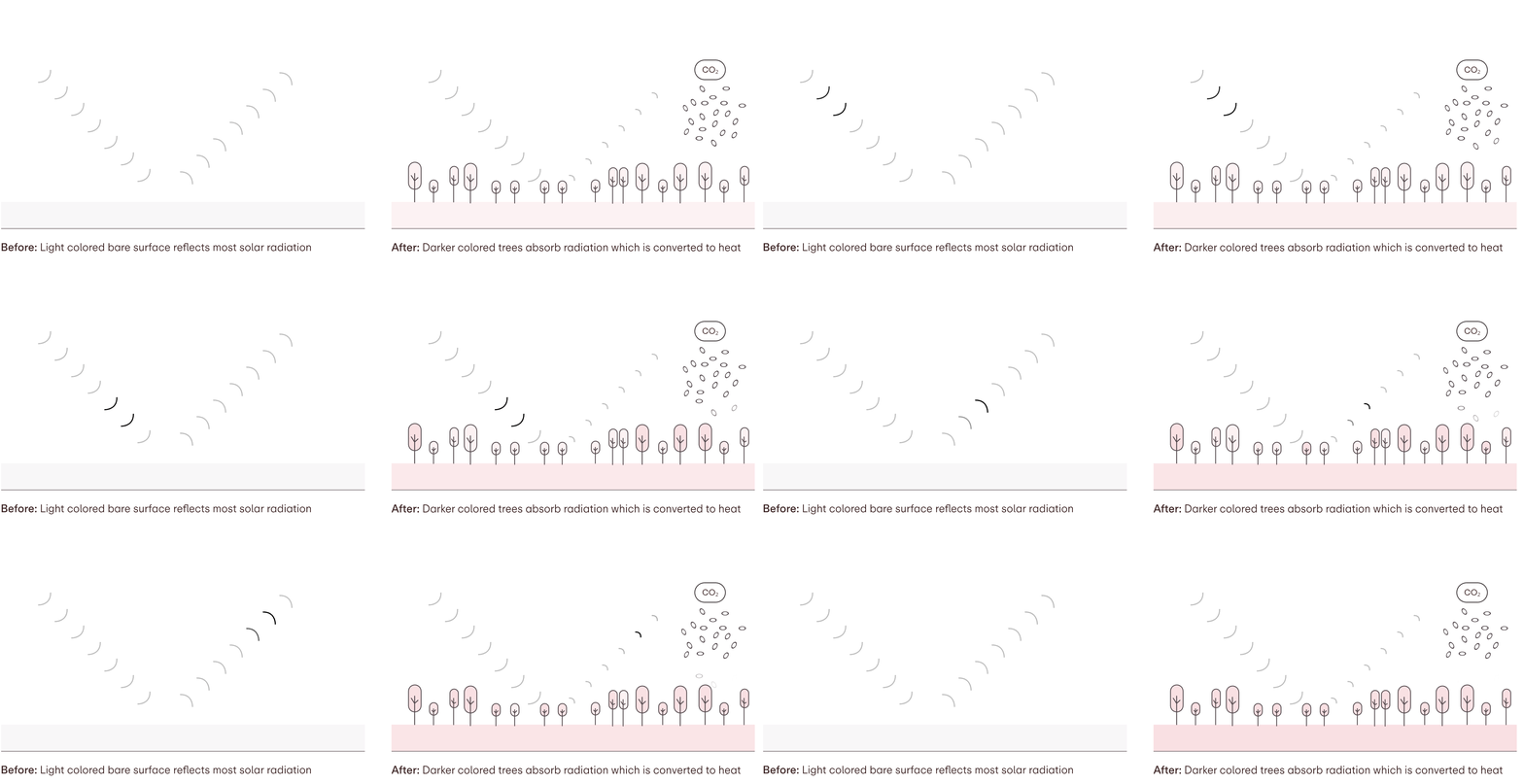
When trees are added to a landscape as part of a reforestation project, this can change the albedo of the surface. Crucially, this change in albedo does not always have a cooling effect on the climate. Trees and forest canopies are often darker than the surfaces they replace—whether that's grassland, bare soil, or snow-covered ground. This means forests typically absorb more solar energy than these lighter surfaces.
When planting trees makes the land surface darker it means more solar energy will be absorbed, creating a warming effect. Depending on how much carbon the forest removes, this warming effect from the albedo change can outweigh some or even all of the climate benefit of the carbon removal from the project.
A recent study even found that albedo changes could wholly negate the cooling effect of up to 12% of afforestation, reforestation, and revegetation projects reviewed, making albedo a critical factor for buyers seeking high-quality carbon removal.
Isometric's approach to albedo
Isometric's Reforestation Protocol is the first on the market to account for albedo changes, and our Agroforestry Protocol follows the same approach. Under our protocol, reforestation projects cannot include any land areas where reforestation is predicted to have a warming effect on the planet when including albedo effects. This decision was guided by three key principles, which also shape how we assess eligibility under this requirement:
Mitigating climate change
While reforestation projects can have a variety of non-climate environmental and social co-benefits, the ultimate goal is to mitigate climate change. Therefore, we only issue carbon removal certificates to projects that have a net cooling impact on the climate.
If the albedo impacts of a reforestation project are predicted to completely offset the carbon removal benefits, the project is very unlikely to mitigate climate change. Due to this, Isometric integrated albedo change as a key eligibility requirement: we do not allow projects to contain any areas where albedo changes are predicted to have a net warming impact.
Globally accessible but locally relevant
Whenever Isometric brings novel requirements to the market, we also consider how that requirement can be assessed in a standardized way around the globe, without burdening project developers. For albedo, Isometric's approach is to use the peer-reviewed global dataset developed by Hasler et al., (2024), which characterizes the net climate impact of reforestation from the combined effects of carbon removal and albedo change.
We've integrated this dataset into our Area Suitability Check tool so that project developers can simply upload their project boundary and immediately see if there are any areas within their project that are projected to have a net warming impact.
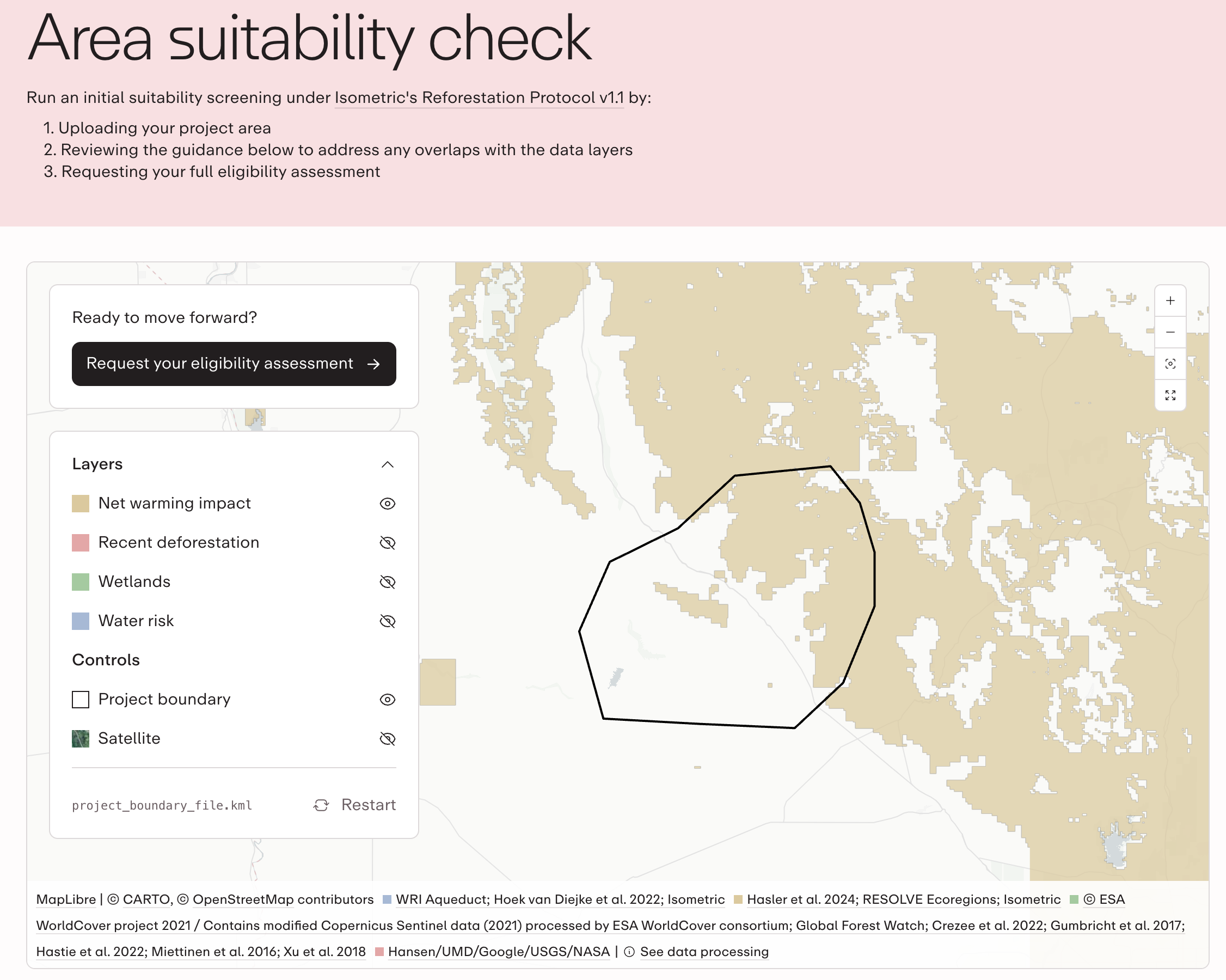
That said, it's important to recognize that there are scenarios where global datasets may not be well-suited to all areas, due to factors like complex topography or variable land cover. Because of this, the Reforestation Protocol also allows evidence from other local or regional scientific studies to demonstrate positive climate benefits. If net warming is indicated in our initial screening, we also check whether the land cover change modeled within the Hasler data is representative of the project site and refine the analysis, if needed.
Evolving with the science
When using the latest peer-reviewed datasets to advance reforestation, we recognize there is some level of uncertainty in scientific research. In the initial screening of projects using the Hasler et al. dataset, Isometric set thresholds specific to different ecosystem types to be inclusive of this uncertainty. In this way, the screening aims to exclude project areas where it is strongly indicated that the entire climate benefit from carbon removal will be negated by the effects of the albedo change.
As more research and data become available, we will continue to re-evaluate and refine our approach to ensure we are rigorously evaluating projects with the best information available. This may involve bringing in additional datasets and analyses that characterize albedo impacts, as well as other feedbacks between forests and climate.
Setting the benchmark
Isometric's goal in accounting for albedo is to use the best scientific information available to ensure that reforestation projects are actually combatting climate change.
We are not alone in pushing for more rigor. This decision reflects growing calls from the scientific community, as well as demand within the market. Notably, the Symbiosis Coalition—a group of carbon removal buyers focused on nature-based approaches—has made a similar decision to include consideration of albedo effects in their quality criteria for projects.
While Isometric is the first certifier to account for albedo, we hope we are not the last.
To learn more, read about why nature-based projects get overcredited.
